


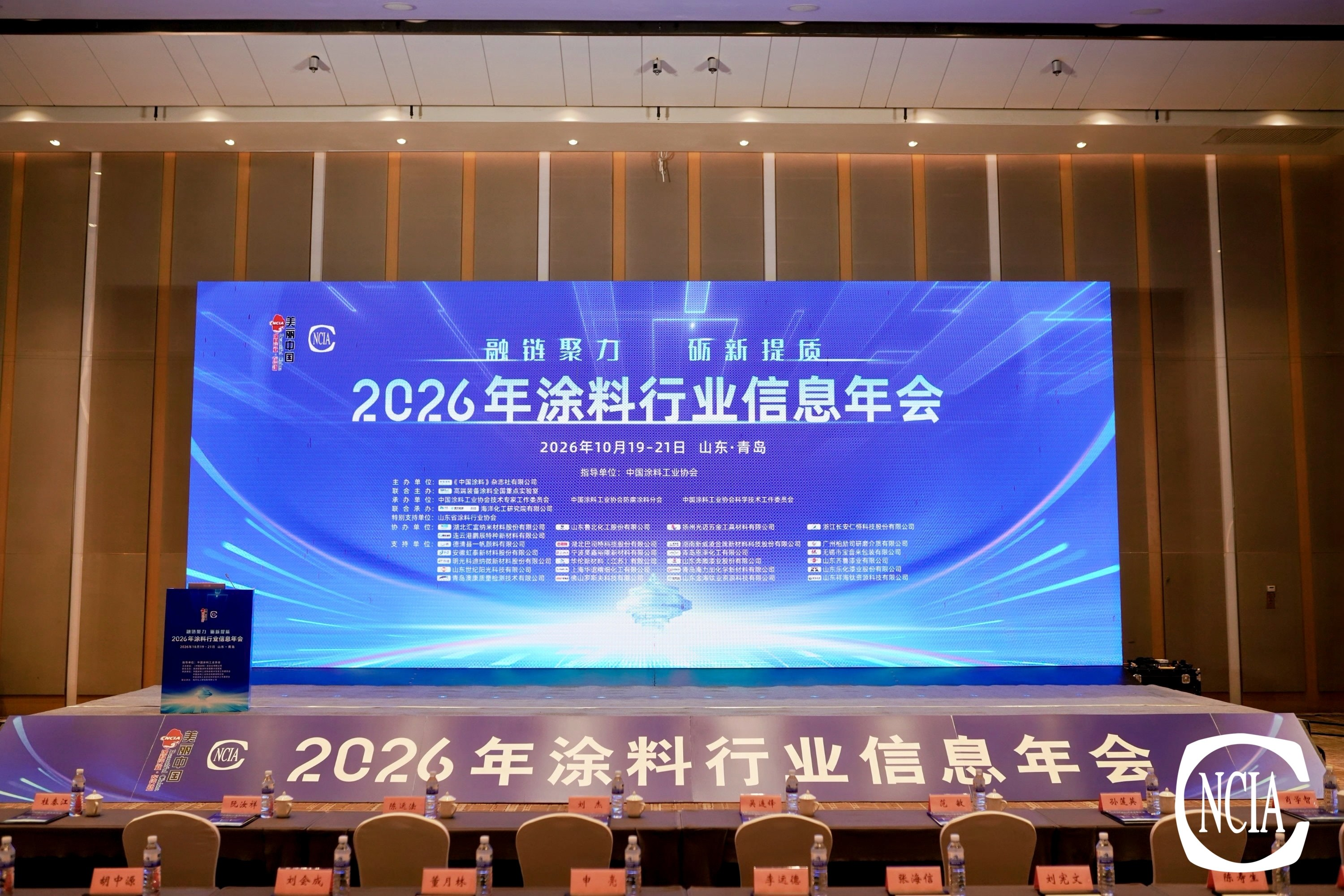
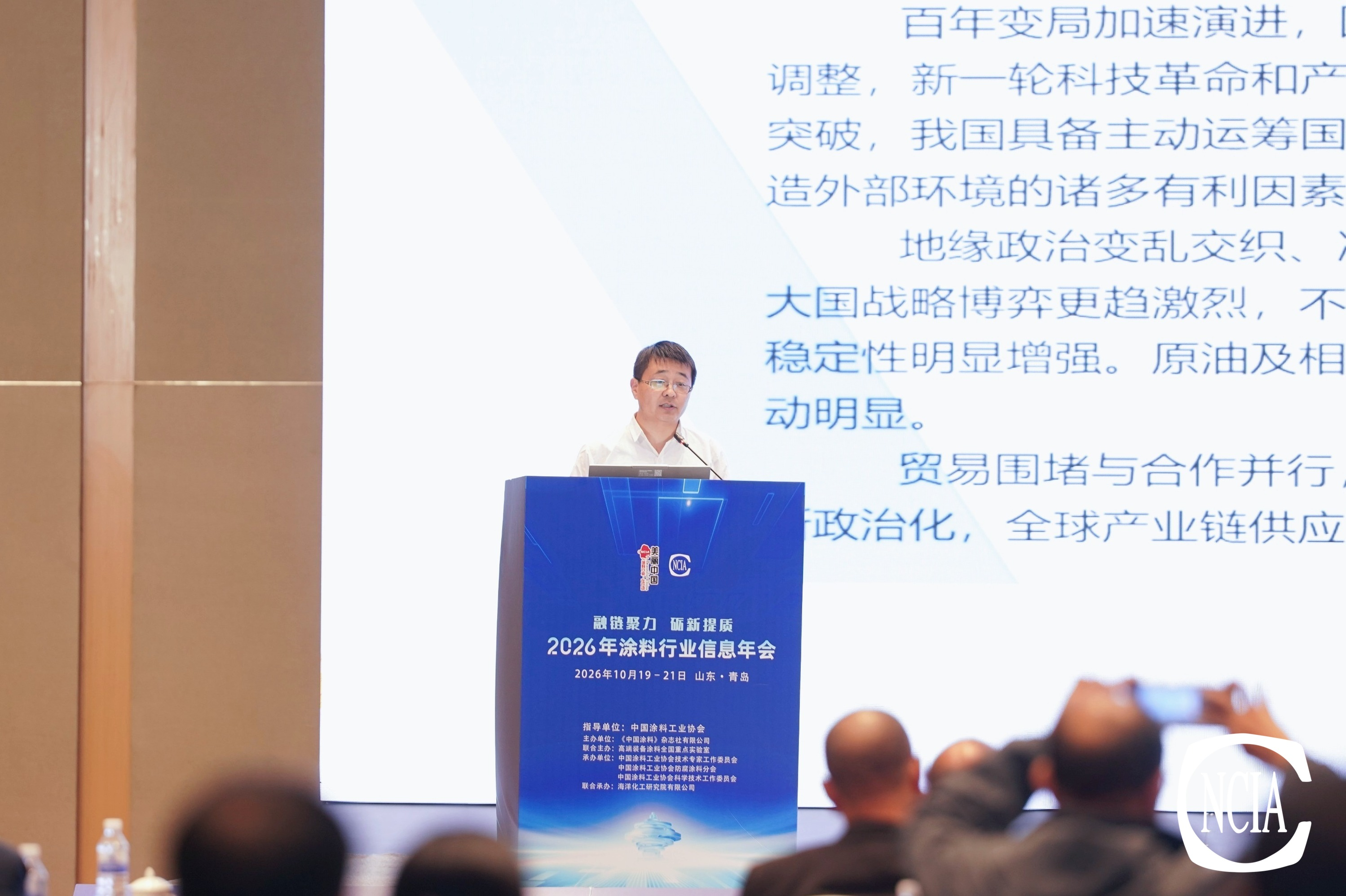
The 2026 China Coatings Industry Information Annual Conference was held, at which Qi Xiangzhao, Deputy Secretary-General of the China Coatings Industry Association, delivered the report “Analysis of the Economic Operation and Development Trends of the Coatings Industry in the First Three Quarters of 2026.”
The report first reviewed the macroeconomic environment. In the first half of 2026, China’s GDP reached 69.5704 trillion RMB, up 4.7% year on year. The value added of industrial enterprises above designated size rose 5.4% year on year, with manufacturing value added up 5.5%, driving economic growth by 1.7 and 1.4 percentage points, respectively. Qi said the national economy operated within a reasonable range, new quality productive forces were cultivated and expanded, and high-quality development moved toward new and better levels. However, uncertainties markedly increased, including external geopolitical conflicts, fluctuations in crude oil and related industrial chains, trade containment and supply chain restructuring; domestically, prominent contradictions remained, such as insufficient effective demand, strong supply but weak demand, and “involution-style” competition.
From the perspective of downstream demand, the coatings market showed clear divergence. The real estate industry continued deep structural adjustment, and demand for furniture in the consumer sector continued to decline. Under the combined impact of the “two new” (large-scale equipment renewals and consumer goods trade-ins) and “two major” (major national strategies and security capacity building in key areas) policies and consumer demand, demand in fields such as home appliances and automobiles fluctuated and adjusted. Demand in machinery, new energy, power and related industries grew significantly. The report held that strong demand in machinery, shipbuilding, artificial intelligence, biomedicine and other industries, as well as in major infrastructure projects such as power and new energy, is becoming a new driver of demand growth for the coatings and pigments industry. Traditional industries face challenges in expanding scale, while emerging pillar industries urgently need growth.
From January to August 2026, China’s total coatings output was 21.427 million tonnes, down 4.4% year on year. Total main business revenue was 236.65 billion RMB, down 0.03% year on year. Total profit was 15.51 billion RMB, down 14.7% year on year, and pressure on industry profitability still warrants attention. Starting in March 2026, affected by geopolitical conflicts, soaring prices along the oil chain drove up prices in the upstream coatings supply chain, significantly squeezing corporate profit margins. Enterprise sales rose slightly in the second quarter, but production declined markedly under the impact of low profits and weak market demand. On a month-on-month basis, profits fell rapidly in the second quarter, edged up and stabilized in June, while production and sales generally rose month on month.
In terms of prices and costs, the China Coatings Industry Price Index, jointly compiled and released by the China Coatings Industry Association and iBuyChem (iBuyChem), showed that the finished coatings price index generally moved upward in 2026, while the procurement cost index first rose and then fell but remained higher than a year earlier. The report judged that raw material procurement will remain at medium-to-high price levels in the fourth quarter, and finished coatings prices will edge upward.
In contrast to domestic pressure, imports and exports became a bright spot for the industry. From January to August 2026, coatings exports reached 338,300 tonnes and US$988 million, up 32.95% and 26.84% year on year, respectively. Titanium dioxide pigment exports totaled 1.3568 million tonnes and US$2.859 billion, up 14.01% and 18.86% year on year, respectively; among them, chloride-process titanium dioxide exports reached 338,300 tonnes, up 49.21%; iron oxide pigment exports were 218,600 tonnes, up 5.95%. The three product categories combined exported 1.9138 million tonnes worth US$4.052 billion, with net exports of 1.6345 million tonnes worth US$2.428 billion, a rapid rebound compared with 2025. Qi further noted that double-digit growth in both coatings export volume and value, with import volume falling below 100,000 tonnes, reflected significantly enhanced international recognition and applicability of China’s coatings industry, leapfrog growth in overseas business and a marked decline in external dependence.
Looking ahead to the full year, Qi said the industry will remain in a period of transformation and adjustment, and green and low-carbon policies will continue to constrain the development of high-pollution and high-energy-consumption industries. Demand will continue to grow in fields such as wind and solar power and energy storage, machinery and equipment, automobiles, ships, large-scale infrastructure protection and building renovation, as well as for energy-saving, antibacterial, antiviral and other functional products. It is estimated that the decline in full-year coatings output will narrow to about -3%; main business revenue is expected to fall by 2%; total profit growth will turn negative under the squeeze of volatile and rising upstream raw materials, structural adjustment of end-user demand and the levy of environmental taxes, with a full-year decline of 8% expected; and the industry as a whole will continue to operate under pressure. Coatings exports will continue to maintain high growth, and annual export volume growth is expected to remain above 20%.